


Semaglutide in Substance Use Disorders: Addiction Models
Substance Addiction Models and Pharmacodynamic Evaluation of Semaglutide in the Treatment of Substance Use Disorders
OncoWuXi Express will continue to keep you informed of updates to our online pharmacology model database (OncoWuXi Database) and our recent progress in preclinical research. In this issue, we are pleased to introduce our substance addiction models and evaluation of semaglutide in anti-addiction.

Substance addiction is a chronic, relapsing brain disease. Currently, approximately 280 million people worldwide suffer from Alcohol Use Disorder (AUD), and the abuse of substances such as opioids and cocaine remains equally severe. This not only devastates individual health but also imposes a heavy social burden [1]. However, current pharmacological interventions for addiction are highly limited and plagued by significant inter-individual variability in efficacy and stubbornly high relapse rates. There is an urgent clinical need to explore novel therapeutic targets and strategies [2].
The Glucagon-Like Peptide-1 (GLP-1) receptor agonist semaglutide was initially used for the treatment of type 2 diabetes and obesity [3, 4]. In recent years, it has garnered significant attention for its unexpected potential in modulating the neural reward system [5]. Preliminary clinical observations and animal studies indicate that semaglutide can reduce overall craving and intake of alcohol and addictive substances by acting on the mesolimbic dopamine system, thereby opening a brand-new perspective for “drug repurposing.”
Driven by these clinical needs and the latest R&D trends, WuXi Biology conducted efficacy studies of semaglutide in animal models of AUD and Cocaine Use Disorder (CUD). We successfully established an Intermittent Access to Two-Bottle Choice (IA2BC) drinking model and a drug-induced Conditioned Place Preference (CPP) model. Through these, WuXi Biology systematically evaluated the intervention efficacy of semaglutide on alcohol intake, alcohol preference, and the expression of cocaine-addictive behaviors in rats. These established models provide powerful drug screening tools and standardized positive control references for substance addiction research.
Case Study 1: Efficacy Evaluation of Semaglutide in the IA2BC Drinking Model
The intermittent access to IA2BC drinking model is a classical experimental paradigm that allows animals to freely choose between pure water and an alcohol solution at specific intervals (e.g., every other day). Its core feature is that “intermittent access” induces stable, high-level voluntary alcohol intake and preference in animals, closely mimicking human intermittent heavy drinking behavior observed clinically (Figure 1). As a classical efficacy evaluation tool in addiction research, this model possesses three core advantages:
- Good Face Validity: It directly reproduces the human behavioral pattern of intermittent, heavy drinking.
- Excellent Construct Validity: The drinking behavior induced by this model is driven by mechanisms such as alternating positive and negative reinforcement mediated by the mesolimbic dopamine system, accurately mimicking the core motivational dysregulation of AUD.
- Reliable Predictive Validity: Clinically proven therapeutics for alcohol dependence (such as naltrexone and acamprosate) can reduce alcohol intake to a certain degree in this model, fully demonstrating its reliability as a drug screening tool.
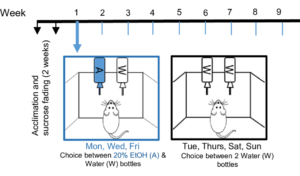
Figure 1. Schematic diagram of the IA2BC drinking paradigm in rats [6]
The training period for the IA2BC drinking model lasts for 8 weeks (Figure 2). As training progressed, the animals exhibited a gradual increase in ethanol intake (Figure 3B) and ethanol preference (Figure 3D). By the end of the training phase, the animals had reached a state of alcohol dependence, characterized by sustained, high levels of ethanol intake and preference (Figures 3B and 3D), indicating the successful and expected establishment of the model.

Figure 2. Schematic timeline of the IA2BC drinking experiment in rats
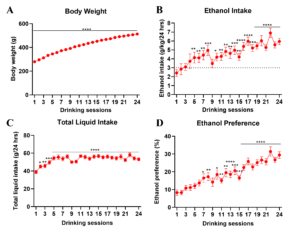
Figure 3. Time-course results during the training phase of the IA2BC drinking experiment in rats: Data are expressed as mean ± SEM. Mixed-effects analysis with Dunnett’s post hoc analysis: *p<0.05, **p<0.01, ***p<0.001, ****p<0.0001 versus Drinking session 1. n = 52/group. Ethanol preference (%) = 24 hrs Ethanol Intake (g)/ 24 hrs Total Liquid Intake (g) x 100.
Efficacy evaluation revealed that semaglutide significantly suppressed the 24-hour ethanol intake (Figure 4C) and ethanol preference (Figure 4D) in alcohol-dependent animals following both the initial administration and the second administration one week later. Simultaneously, the weight-loss effect induced by the initial administration lasted approximately one week, whereas the weight-loss effect from the second administration lasted about 48 hours (Figure 4A).
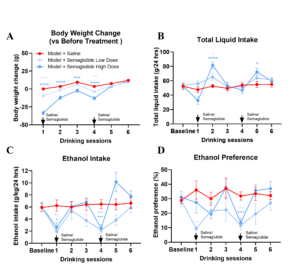
Figure 4. Efficacy evaluation of semaglutide in the rat IA2BC drinking model
Data are expressed as mean ± SEM. Mixed-effects analysis or repeated measures two-way ANOVA with Dunnett’s post-hoc analysis: *p<0.05, **p<0.01, ***p<0.001, ****p<0.0001 versus Model + Saline group. n=13/group.
Case Study 2: Efficacy Study of Semaglutide in the Conditioned Place Preference (CPP) Model
CPP model is a classical behavioral paradigm based on Pavlovian conditioning. It repeatedly pairs the drug’s rewarding effects with specific environmental cues. By observing the time animals spend in the drug-paired chamber, it directly quantifies drug-induced conditioned rewarding effects and addiction memory. The core feature of the CPP model is its ability to specifically isolate the rewarding effects of drugs, making it the “gold standard” for evaluating substance addictive potential and cue-induced drug-seeking behavior. This model possesses the following advantages in addiction research:
- Good Face Validity: The increased time animals spend in the drug-paired chamber directly mimics the conditioned craving and drug-seeking behaviors triggered in human addicts upon exposure to drug-associated cues;
- Rigorous Construct Validity: Based on the theory of Pavlovian conditioning, it reproduces the associative memory between drug-rewarding effects and environmental cues—a core mechanism of addiction mediated by the mesolimbic dopamine system;
- Reliable Predictive Validity: Substances with abuse potential can reliably induce conditioned place preference, whereas clinically effective anti-relapse drugs can inhibit its expression.
In the cocaine-induced animal CPP experiment (Figure 5), following a standard training procedure, the animals reached a state of cocaine addiction, characterized by a significant increase in the time spent in the drug-paired chamber (Figure 6A). Notably, a single administration of semaglutide significantly inhibited the expression of cocaine-induced CPP in animals (Figure 6A), but had no significant effect on the extinction (weakening of an established place preference through repeated unrewarded context exposure) and reinstatement (the re-emergence of that place preference after the extinction and is triggered by a precipitating factor for relapse) of CPP (Figures 6B, 6C).

Figure 5. Schematic diagram of the experimental procedure for cocaine-induced CPP in rats
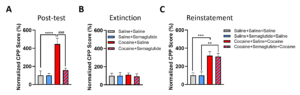
Figure 6. Efficacy evaluation of semaglutide on the expression of cocaine-induced CPP in rats
Data are expressed as Mean + SEM. One way ANOVA with Sidak‘s multiple comparisons test: **p<0.001, ***p<0.001,****p<0.0001 versus corresponding saline + Saline/Semaglutide (+ Saline) group; ###p <0.001 versus Cocaine + Saline group. n=11~12/group. CPP score are normalized to corresponding Saline + Saline/Semaglutide (+ Saline) group. Post-test CPP score = (Tdrug paired (post-test) – Tdrug paired (pre-test)); Extinction CPP score = (Tdrug paired (extinction-test) – Tdrug paired (pre-test)); Reinstatement CPP score = (Tdrug paired (reinstatement-test) – Tdrug paired (pre-test)).
Summary
To comprehensively and accurately evaluate the intervention efficacy of candidate drugs on substance addiction, WuXi Biology has established a robust behavioral testing system for substance use disorders. This system encompasses a diverse array of addiction-related animal behavioral paradigms, including: CPP models in mice and rats, Self-Administration (SA) models in rats, IA2BC drinking models in rats, Binge Drinking models in mice, and Ethanol Behavioral Sensitization models.
Furthermore, the platform possesses full regulatory qualifications for the compliant use of psychoactive and narcotic drugs, enabling us to conduct in vivo experiments involving strictly controlled substances such as opioids (e.g., morphine and fentanyl), cocaine, ketamine, and nicotine. Moreover, a comprehensive range of addictive agents has been fully validated within the aforementioned behavioral paradigms. This facilitates the systematic evaluation of diverse test compounds across different substance dependence spectrums and behavioral stages, ultimately empowering our partners in the research and development of novel anti-addiction therapeutics.
References:
[1] Klausen, M. K., Thomsen, M., Wortwein, G., & Fink-Jensen, A. (2022). The role of glucagon-like peptide 1 (GLP-1) in addictive disorders. British journal of pharmacology, 179(4), 625–641.
[2] Aranäs, C., Edvardsson, C. E., Shevchouk, O. T., Zhang, Q., Witley, S., Blid Sköldheden, S., Zentveld, L., Vallöf, D., Tufvesson-Alm, M., & Jerlhag, E. (2023). Semaglutide reduces alcohol intake and relapse-like drinking in male and female rats. EBioMedicine, 93, 104642.
[3] Nauck MA, Quast DR, Wefers J, Meier JJ. GLP-1 receptor agonists in the treatment of type 2 diabetes – state-of-the-art. Mol Metab.2021;46:101102.
[4] Wilding JPH, Batterham RL, Calanna S, et al. Once-weekly semaglutide in adults with overweight or obesity. N Engl J Med. 2021;384(11):989–1002.
[5] Klausen, M. K., Thomsen, M., Wortwein, G., & Fink-Jensen, A. (2022). The role of glucagon-like peptide 1 (GLP-1) in addictive disorders. British journal of pharmacology, 179(4), 625–641.
[6] Decker, S., Davis, G., Vahora, I., Vukovic, A., Patel, P., & Suryanarayanan, A. (2022). Desformylflustrabromine (dFBr), a positive allosteric modulator of α4β2 nicotinic acetylcholine receptors decreases voluntary ethanol consumption and preference in male and female Sprague-Dawley rats. PloS one, 17(9), e0273715.
If you have any questions or need further information, please contact us at:
Business Consulting:
Technical Consultation:
Pharmacology-BD-Translation@wuxiapptec.com
Scan the QR code below to register at our OncoWuXi database for free.
For more pharmacological model data, information, and consultation.

Related Content
CNS drug development remains one of the most complex challenges in biopharmaceutical research—from target validation and brain exposure to translational...
VIEW RESOURCEEstablishment and Efficacy Evaluation of α-Synuclein-Based Animal Models of Parkinson’s Disease OncoWuXi Express will continue to keep you informed about...
VIEW RESOURCE