


Enhancing Treatment of MASH with Combination Therapies
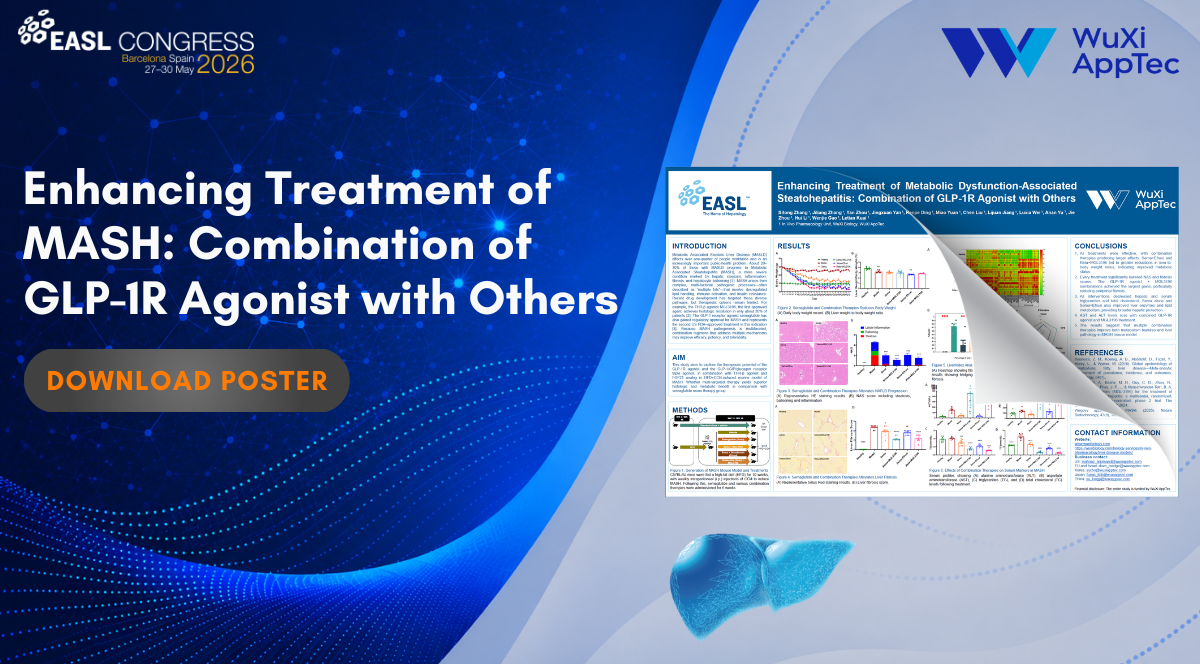
Metabolic dysfunction-associated steatohepatitis (MASH) remains a significant global health challenge, driven by a complex interplay of lipid dysregulation, inflammation, and fibrosis. Because multiple biological pathways contribute to disease progression, combination therapies that target complementary mechanisms may offer greater therapeutic benefit than single-agent approaches.
At EASL 2026, WuXi Biology presented a poster evaluating combination therapies in an HFD+CCl4-induced murine model of MASH. The study examined semaglutide, a GLP-1 receptor agonist, and retatrutide, a GLP-1/GIP/glucagon receptor triple agonist, in combination with a THR-β agonist or an FGF21 analog to determine whether multi-targeted approaches could deliver greater benefits than semaglutide monotherapy.
The results showed that all treatment groups improved key disease endpoints, while several combination regimens produced greater reductions in liver pathology and fibrosis. Notably, GLP-1R agonist and THR-β agonist combinations demonstrated particularly strong improvements in NAS and fibrosis scores, highlighting the potential of combination strategies to address the complex biology of MASH.
Poster_EASL_Enhancing Treatment of MASH_Combination of GLP-1R Agonist with Others
Related Content
Metabolic dysfunction-associated alcohol-related liver disease (MetALD) presents unique challenges for preclinical drug development, requiring models that capture the combined effects...
VIEW RESOURCEOvercoming Osteoporosis R&D Bottlenecks with Multi-Dimensional OVX Models Against the backdrop of an actively aging global population, osteoporosis has emerged...
VIEW RESOURCE